
Syracuse and the surrounding Onondaga County area
Paver Patios, Walkways and Stone Steps in Syracuse
Have a patio, walkway, driveway or set of stone steps built in unit pavers or natural stone, with the base depth, the compaction and the drainage written into the quote as numbers you can check.
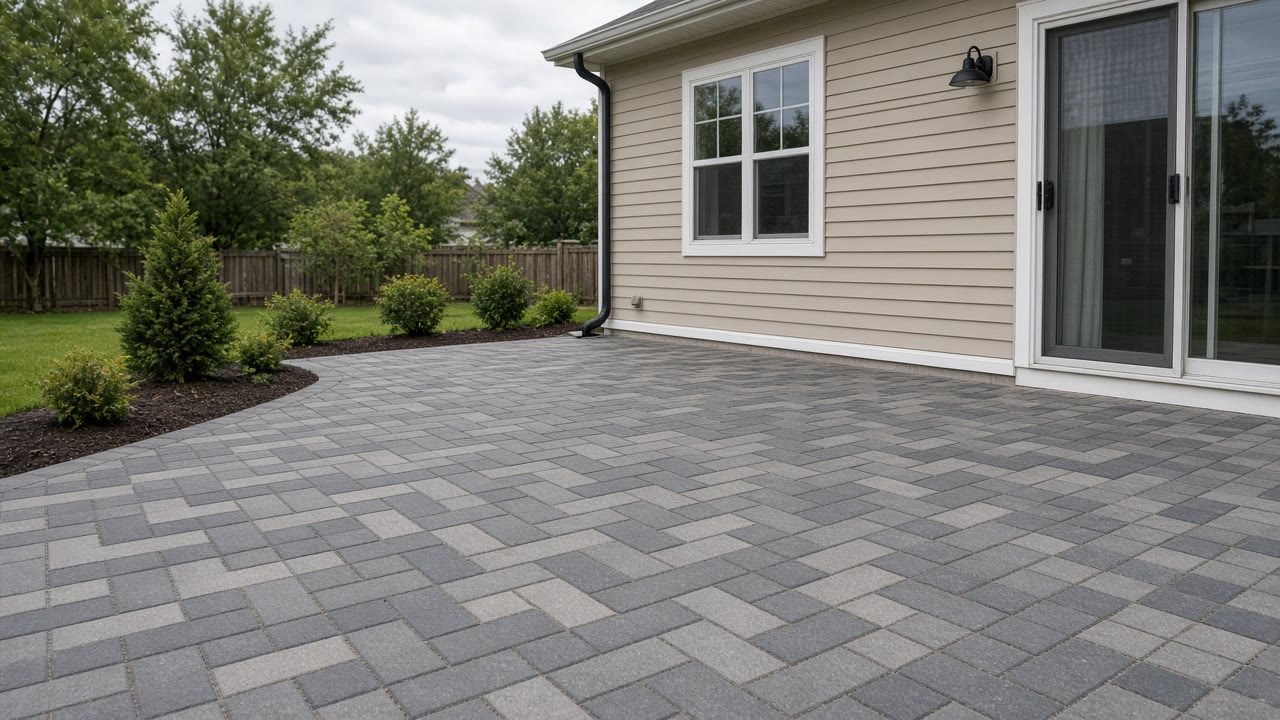
Paver Patio Installation quote
Tell us the rough size, what is there now, and whether the ground holds water after rain. We pass it to licensed, insured hardscape crews who will put a base depth and a drainage detail in writing.
Would you rather talk it through? Call (315) 640-3590, answered 24/7.
$100 off your first job
Credited by us on your first booked job.
- One credit per customer per property, on your first booked job.
- Valid through December 31, 2026.
Mention this offer when you book. Full terms.
What a paver patio is, from the stone down to the subgrade
Unit paving is built from the subgrade upward. The ground is excavated, the exposed subgrade is compacted, an open-graded base goes in and is compacted in lifts, a thin bedding layer is screeded over it, and the pavers or stone are set, edge-restrained and jointed. The base is most of the work and none of the photograph. The hardscape industry's own specification sets base thickness by traffic, soil type, subgrade drainage and moisture, and climate: a minimum of 4 inches after compaction for patios, walkways and pedestrian areas over well-drained soils, at least 6 inches for a residential driveway, and thicker again in colder climates over continually wet or weak soils. It treats subsurface drainage as a design item rather than an extra. Unit paving is also a flexible surface by design, which is the real difference from one rigid piece of concrete: it moves at the joints instead of cracking across the middle, and it can be lifted and reset.
- Concrete paver patios, and bluestone or natural stone patios set on a compacted base
- Front walks, side paths and garden paths in pavers or flagstone
- Natural stone and precast steps, landings and stoops
- Paver driveways and parking aprons, which carry a deeper base than any patio
- Excavation, subgrade compaction, geotextile separation and subgrade stabilization on soft ground
- Perimeter subsurface drainage: perforated pipe bedded in open-graded stone and wrapped in geotextile
- Edge restraint, bedding and joint sand, and a finished fall that moves water off the surface
- Lifting and resetting a settled area of an existing paver field where the base under it is still sound
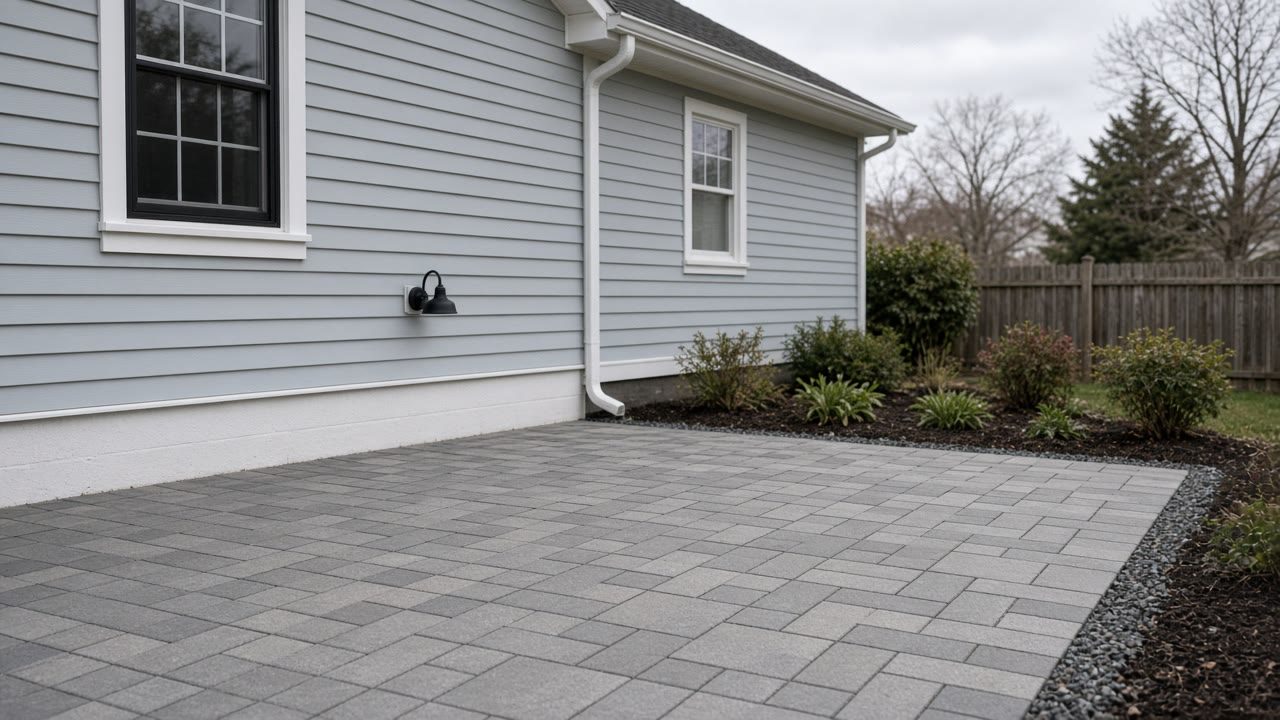
The part of a patio price you never get to see
Three quotes for the same patio will show you the same stone and differ by thousands. Nearly all of that difference is under the pavers, and this is where it hides.
Which soil your own address sits on
The two largest soil map units in Onondaga County pull opposite ways. Honeoye silt loam, about 29,876 acres on 3 to 8 percent slopes, is classed well drained, hydrologic group B. Niagara silt loam, about 23,452 acres on 0 to 4 percent slopes, is somewhat poorly drained, group C over D. Two houses fifteen minutes apart can sit at opposite ends of that scale, so a base depth quoted from a rule of thumb is a guess.
The base depth, stated in inches after compaction
The industry minimum is 4 inches for a patio or walkway over well-drained soil and 6 inches for a residential driveway, and the specification says colder climates over continually wet or weak soils need thicker bases. The 2020 edition of the same bulletin put that adjustment at 2 to 4 inches more, which would read as 6 to 8 inches for a patio here; the current edition states only that the base must be thicker. Either way the number belongs in your quote rather than in a conversation.
Whether the seasonal water table sits inside the excavation
Niagara silt loam, the second most extensive soil in the county and the dominant soil across the northern towns, carries a seasonal high water table about 31 centimeters down, roughly 12 inches, and the county soil data records that condition for December through May. Those are the freezing months. Kendaia silt loam is shallower again at roughly 8 inches.
Whether compaction is a number or a feeling
The specification asks for the soil subgrade to be compacted to at least 98 percent of standard Proctor density under ASTM D698, and adds that the number may not be achievable in extremely saturated or very fine soils without stabilizing the subgrade first. A plate compactor run over loose fill is not the same purchase.
Lift thickness, and the fall across the finished surface
Base material is to be spread and compacted in 4 to 6 inch lifts with a 7,000 pound-force reversible plate, and thinner lifts with a lighter machine. A 6 inch base placed in one pass is not a compacted 6 inch base. The finished surface wants a minimum slope of 1.5 percent, about 3/16 inch of fall per foot, which is small enough that a patio built dead level looks right and then holds water.
Where water leaves the assembly
The specification recommends drain pipes in clay and other slow-draining soils, and describes the assembly: a 4 inch perforated pipe surrounded by at least 3 inches of No. 57 or similar open-graded stone, wrapped in geotextile, set with the top of the stone level with the compacted subgrade and run around the perimeter to outlets. On that soil a quote with no drainage line on it is quoting a shallower job than it looks.
The month the base goes in
The hardscape specification's cold weather rule is absolute: frozen base material must not be installed, and material must not be placed over a frozen soil subgrade. Frozen ground that gets built on thaws into a void under your patio in April, which is why an unusually cheap late-winter start date is worth a question.
Whether any part of the project carries a footing
A patio at grade does not. Steps that tie into the house, pillars and anything holding weight bring in the frost question, which is a different question with a different answer and, in New York, one your own municipality answers rather than the state.
Get the base depth in writing
A number in inches after compaction, and a line that says where water leaves. Send us the project and we will put it to crews who quote that way.
How a patio gets built, subgrade upward
Get a written contract with real dates in it
New York General Business Law section 770(3) names driveways, terraces, patios, landscaping and fences as home improvement by name, so every protection in Article 36-A applies to a patio. Section 771(1)(b) requires the approximate start and substantial completion dates and any contingencies that would move completion, and requires the contract to say whether a definite completion date is of the essence. Decide that deliberately if you have an event in mind.
Look your own soil up, then dig a test hole
The NRCS Web Soil Survey will tell you which map unit your address falls in and how it is classed for drainage. A hole tells you what the map cannot: what is actually under the lawn and where water stands. Do both before the quotes are finalized, not after.
Excavate and compact the subgrade
The subgrade is the foundation of a flexible surface, and the target is at least 98 percent of standard Proctor. Where the specification's own caveat applies, on saturated or very fine soils, the answer is stabilization rather than pressing on and hoping.
Install the drainage before the base, not afterward
A perimeter perforated pipe in open-graded stone wrapped in geotextile goes in with its stone level with the compacted subgrade, sloped to an outlet. Retrofitting drainage under a finished patio means taking the patio up.
Base in lifts, each one compacted
4 to 6 inch lifts, compacted as they go, to the depth written in the contract. This is the stage where a price gets quietly cheaper and where nothing shows afterward.
Bedding, pavers, edge restraint, joints
The specification notes that pavers may be set 1/8 to 1/4 inch above final elevation to allow for minor settling, and states plainly that a small amount of settling is typical of all flexible surfaces. The edge restraint is what stops the field from spreading.
Check the fall, then pay against the schedule
Water off the surface at 1.5 percent or better, checked before the final payment rather than after the first storm. Section 771(1)(f) requires progress payments to be scheduled in dollars and cents against a named state of completion, which on this job reads naturally as materials delivered, excavation and base complete, paving complete.
What paver patio installation looks like
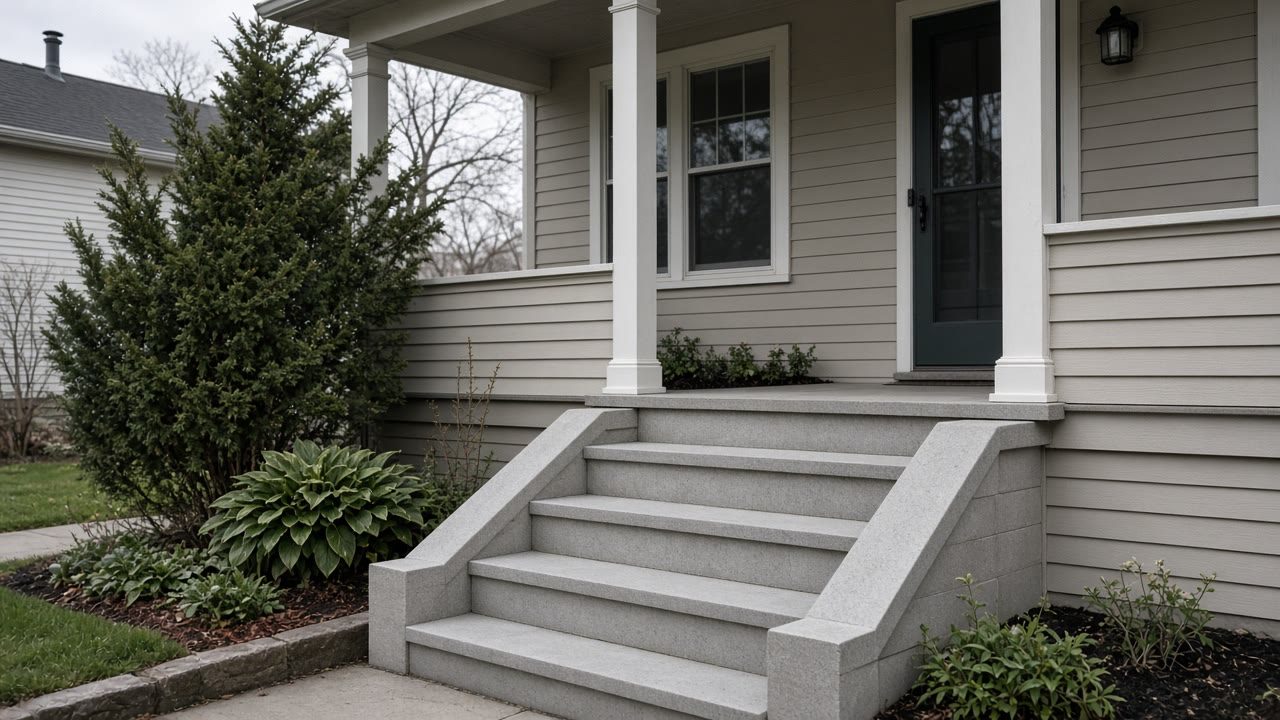
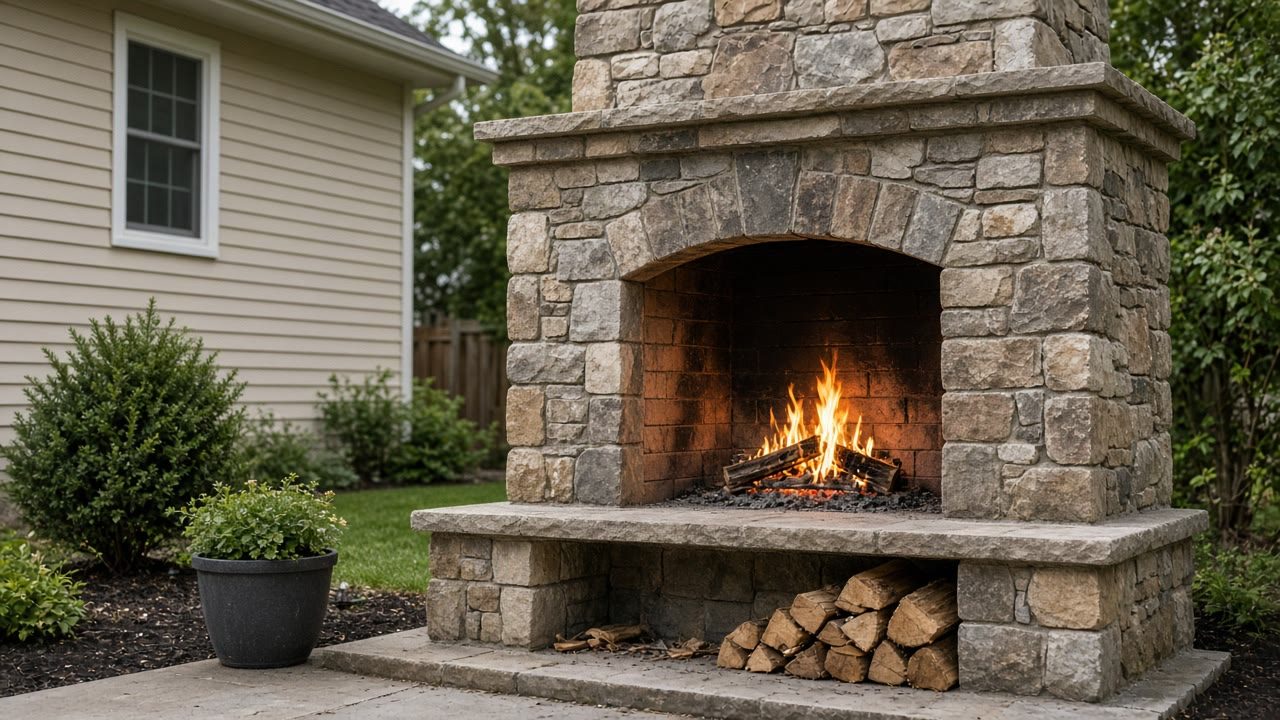
Where paver and stone work starts and stops
When you may not need this at all
- If one corner of your existing patio has dropped and the rest is flat and tight, that area can often be lifted, the base re-graded and the same pavers reset. It is a fraction of a rebuild, and being able to do that is the whole point of unit paving.
- If what you want is a poured concrete slab, apron, driveway or set of poured steps, that is a different trade with different questions, and a crew that only lays unit paving is the wrong crew to price it. Poured concrete is the right answer for plenty of drives and walks, and saying so costs us nothing.
- A patio at grade carries no footing. If someone tells you your patio has to be dug to frost depth, ask which structure they are describing, because it is not a patio.
- If the ground you want to pave holds standing water after rain, the drainage is the job and the paving is the finish. A drainage answer first can change the design, and occasionally the location.
- Some settlement is expected on any flexible surface and the industry specification says so in as many words. Nobody can honestly sell you a paver field that never moves. What you are buying is compaction, drainage and the ability to lift and reset.
- In February the ground here is frozen and the specification forbids building on it. There is no version of that job worth booking, whatever the price.
What is out of scope
- Poured concrete flatwork of any kind: driveways, aprons, garage slabs, poured steps, sidewalks and slab leveling. Different trade, different questions, and a reader who wants poured should go and get it priced properly.
- Retaining walls, and any wall whose job is holding back earth. A failing, leaning or bulging wall needs a repair trade rather than a hardscape crew.
- Asphalt paving and sealcoating.
- Lawn, planting, irrigation and low-voltage lighting, beyond backfilling and restoring the edge of the work.
- Sidewalk and curb work in the public right of way, and anything that ties into a municipal storm drain, which needs the municipality's own approval.
- Pool shells, pool equipment and pool barrier requirements. The paving around a pool can be arranged; the pool work cannot.
- Snow removal and de-icing.
Towns where we arrange patio and walkway work
- Paver Patio Installation in Cicero
- Paver Patio Installation in Clay
- Paver Patio Installation in Manlius
- Paver Patio Installation in DeWitt
- Paver Patio Installation in Syracuse
- Paver Patio Installation in Salina
- Paver Patio Installation in North Syracuse
- Paver Patio Installation in East Syracuse
- Paver Patio Installation in Liverpool
- Paver Patio Installation in Camillus
- Paver Patio Installation in Marcellus
- Paver Patio Installation in Skaneateles
- Paver Patio Installation in Baldwinsville
Patio, walkway and step questions
How deep should the base under my patio be?
Deep enough for your soil, and stated in the quote as inches after compaction. The industry specification's minimum is 4 inches for patios, walkways and pedestrian areas over well-drained soils, 6 inches for a residential driveway, and thicker in colder climates over continually wet or weak soils. Syracuse is a freeze-thaw climate and large parts of this metro map as somewhat poorly to poorly drained, so the well-drained minimum is the wrong starting point for many addresses here. Get the number written down and you have made the single largest hidden difference between two prices visible.
Pavers or poured concrete?
Honestly, both are real answers. Unit paving is a flexible surface: it moves at the joints rather than cracking across a span, and any part of it can be lifted and reset, so a settled corner or a buried utility is a morning's work rather than a demolition. Poured concrete is one continuous piece, it is usually simpler to install, and for a long straight drive it is often the more economical surface per square foot. What it cannot do is come up and go back down. If poured is what you want, get it priced by a flatwork contractor rather than by a hardscape crew.
Will my patio move?
A little, and the specification expects it to. Pavers may be set 1/8 to 1/4 inch above final elevation to allow for minor settling, and a small amount of settling is described as typical of all flexible surfaces. What separates a patio that settles a fraction from one that opens up is the compaction of the subgrade, the depth of the base and whether water has somewhere to go. Those three items are what you are actually comparing across your quotes.
Can pavers be laid in winter here?
Not on frozen ground. The hardscape specification states flatly that frozen base material must not be installed and that material must not be placed over a frozen soil subgrade. At Syracuse the normal daily minimum is at or above 40F in exactly six months, May through October, and the median window between the last and first dates at or below 36F is 149 days, May 8 to October 5. That is the genuinely unprotected build season, which is about five months rather than the seven a frost-free reading suggests, and it is why good crews fill up in spring.
Do I need a permit for a patio?
Ask your own municipality, because the published lists in this metro do not settle it. The Town of Clay and the Town of Cicero both name fireplaces on their permit lists and neither names a patio. The City of Syracuse names retaining walls, driveways, fences, decks and porches and neither of its lists mentions a patio at grade. The Town of Manlius publishes thresholds for sheds, decks and fences and none for a patio. Silence is not permission, and zoning setbacks usually decide where a patio can sit even where no building permit is needed. In Cicero, also check the trigger for excavating or filling more than 10 cubic yards, which is about a 20 by 20 foot area taken down 8 inches.
Does a state stormwater permit apply to my patio?
No. New York's construction stormwater permit applies to soil disturbance of one acre or more, and one acre is 43,560 square feet, so no residential patio, walkway or driveway comes close. The lower 5,000 and 20,000 square foot thresholds in that permit apply to New York City watersheds and the city's own boundaries rather than to Onondaga County. It is worth knowing so that nobody adds a state stormwater line to your quote, but your local stormwater ordinance is a separate matter.
What protects my deposit?
Statute, if the contract is written the way the statute requires. Section 771(1)(e) requires the contract to notify you that payments taken before completion are to be deposited under subdivision four of section 71-a of the Lien Law, or that the contractor may instead post a bond, a contract of indemnity or an irrevocable letter of credit with you. Ask which of the three applies before you hand money over. Section 771(1)(h) also gives you until midnight of the third business day after signing to cancel in writing, which is enough time to get a second quote read properly.
Tell us what the ground does after rain
That one answer changes the base, the drainage and the price. Send it with your rough dimensions and there is no obligation either way.