
Paver Patios, Walkways and Stone Steps in Cicero
On the wettest ground in this metro, the base under a Cicero patio matters more than anything you can see.
Paver Patio Installation quote in Cicero
Share a few details so we can confirm coverage and arrange the right next step.
Would you rather talk it through? Call (315) 640-3590, answered 24/7.
$100 off your first job
Credited by us on your first booked job.
- One credit per customer per property, on your first booked job.
- Valid through December 31, 2026.
Mention this offer when you book. Full terms.
Choosing paving for Cicero ground
Cicero is the wettest ground we build on. 59.5 percent of the mapped soil in the town is classed poorly, somewhat poorly or very poorly drained, and only 6.2 percent is well drained. The largest single map unit is Niagara silt loam, which carries a seasonal high water table about 12 inches down from December through May.
The month decides the specification
A base cannot be compacted while it is frozen, so the season sets the schedule here as firmly as the design does. The median window for laying without cold weather measures runs about 149 days, May 8 to October 5.
What is behind and beneath the work
Unit paving is designed to move. It flexes at the joints where a rigid slab would crack, which is why what sits under it, the depth of the base, how well it was compacted and where water leaves, decides how it looks in ten years.
What to ask whoever quotes
Ask how deep the base goes, how it will be compacted and where the water leaves. Those three answers explain most of the gap between two quotes.
What the survey says about Cicero ground
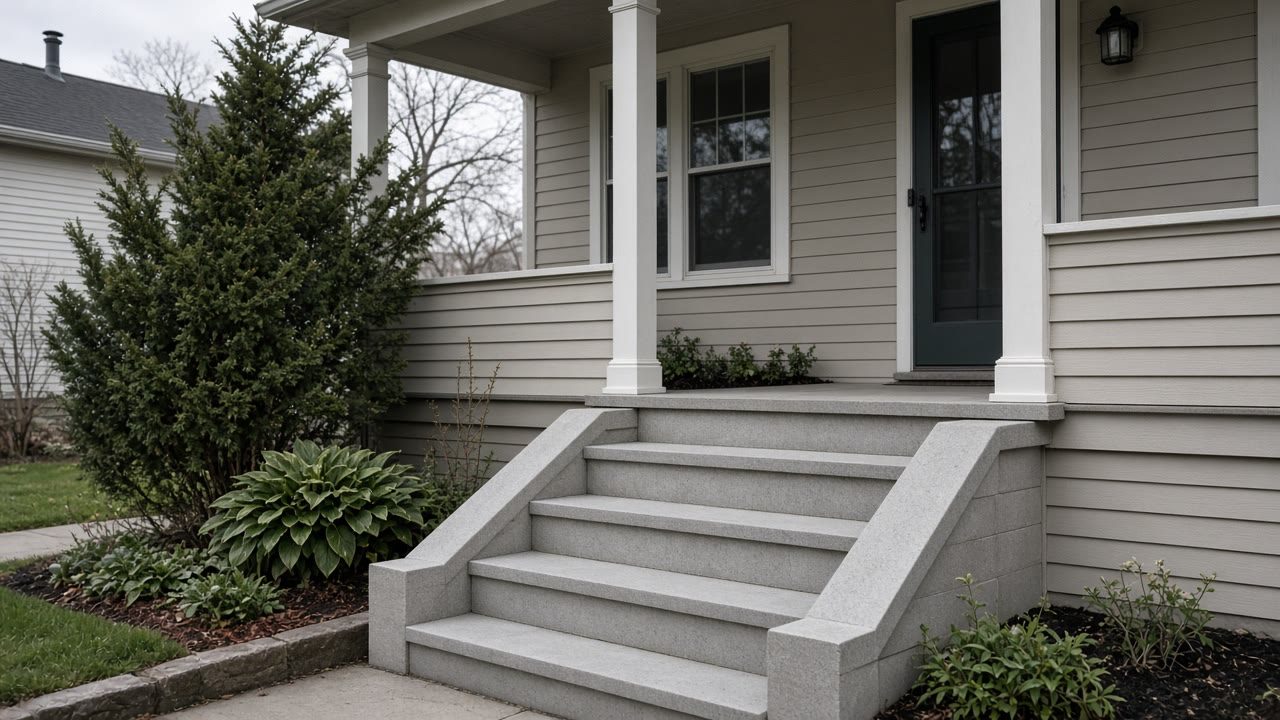
In the Town of Cicero, 59.5 percent of the mapped soil area is classed poorly drained, somewhat poorly drained or very poorly drained, and 6.2 percent is classed well drained. The single largest map unit is Niagara silt loam on 0 to 4 percent slopes at about 28.6 percent of the town, followed by Collamer silt loam at about 12.2 percent and Carlisle muck, a very poorly drained organic soil, at about 12.0 percent.
Source: United States Department of Agriculture, Natural Resources Conservation Service, Soil Survey Geographic Database for Onondaga County New York, survey area NY067, queried through the Soil Data Access service, accessed 2026-09-14
Niagara silt loam, the second most extensive soil in Onondaga County and the dominant soil across the northern towns, carries a seasonal high water table with its top at about 31 centimeters, roughly 12 inches, below the surface, and the county soil data records that condition for December, January, February, March, April and May. Rhinebeck silt loam has the same 31 centimeter figure. Kendaia silt loam is shallower at about 20 centimeters, roughly 8 inches. For comparison, Collamer silt loam is about 54 centimeters, roughly 21 inches, and Honeoye silt loam about 76 centimeters, roughly 30 inches.
Source: United States Department of Agriculture, Natural Resources Conservation Service, Soil Survey Geographic Database for Onondaga County New York, survey area NY067, queried through the Soil Data Access service, accessed 2026-09-14
Both of the fast-growing northern towns name fireplaces on their list of work requiring a building permit and neither names a patio. The Town of Clay lists new buildings, all additions and alterations, mobile homes, garages and barns, pools, sheds and storage buildings, decks and porches, fences, signs, fireplaces, stoves and inserts, and demolition. The Town of Cicero lists decks, porches and garages, fireplaces, pellet stoves and wood stoves, storage sheds no matter the size, fences, swimming pools, and structural, plumbing or electrical alterations, and requires a permit before excavation or filling of more than 10 cubic yards. Cicero also requires a Floodplain Development Permit for any work in a 100 year flood zone, including work that would not otherwise need a permit.
Source: Town of Clay, New York, Department of Planning and Development, Building Permits Information, and Town of Cicero, New York, Department of Zoning and Planning, forms and permits, accessed 2026-09-14
National Flood Insurance Program figures in the county hazard mitigation plan annexes show how differently water behaves across the northern towns. The Town of Cicero has 180 active policies and 153 claims paid totalling about 1.44 million dollars. The Town of Clay has 93 policies and 49 claims paid totalling 455,606 dollars, and no repetitive loss or severe repetitive loss properties. North Syracuse village has 4 policies and has had no claims paid at all, a total of zero dollars. Solvay village has 3 policies and 6 claims paid totalling 10,957 dollars, and East Syracuse village has 9 policies and 12 claims paid totalling 223,722 dollars.
Source: Onondaga County, New York, 2025 Hazard Mitigation Plan, Town of Cicero Annex, Town of Clay Annex and Village of North Syracuse Annex, Onondaga County Department of Planning, accessed 2026-09-14
Ranked by the share of housing units built in 2000 or later, the era in which adhered stone veneer and segmental paver hardscape became the dominant new masonry products, the places of this metro spread very widely. Radisson, the census place inside the Town of Clay, leads at 32.4 percent, followed by the Town of Lysander at 25.8 percent, the Town of Van Buren at 21.9 percent, Baldwinsville village at 20.1 percent, the Town of Cicero at 19.1 percent, the Town of Clay at 15.4 percent, the Town of Camillus at 15.2 percent, the Town of Manlius at 11.6 percent, the Town of Marcellus at 11.3 percent, the Town of Skaneateles at 11.2 percent, Marcellus village at 9.9 percent, the Town of DeWitt at 8.7 percent, Skaneateles village at 8.4 percent, Fayetteville village at 8.1 percent, the Town of Salina at 7.0 percent, the City of Syracuse at 6.4 percent, Camillus village at 6.4 percent, Liverpool village at 6.1 percent, North Syracuse village at 4.7 percent, Manlius village at 4.5 percent, and both East Syracuse village and Solvay village at 0.0 percent. The county figure is 11.6 percent.
Source: US Census Bureau, American Community Survey 2020-2024 5-year estimates, table B25034 Year Structure Built and table B25035 Median Year Structure Built, accessed 2026-09-14
The hardscape industry's own base specification is short and checkable. It states that the thickness of the base is determined by traffic, soil type, subgrade soil drainage and moisture, and climate; that sidewalks, patios and pedestrian areas should have a minimum base thickness after compaction of 4 inches over well-drained soils; that residential driveways on well-drained soils should be at least 6 inches thick; and that in colder climates, continually wet or weak soils will require that bases be thicker.
Source: Concrete Masonry and Hardscapes Association, PAV-TEC-002, Construction of Interlocking Concrete Pavements, accessed 2026-09-14
Compaction is a measurable number, not a matter of judgment. The specification states that compaction of the soil subgrade is critical to the performance of interlocking concrete pavements, that adequate compaction will minimize settlement, and that compaction should be at least 98 percent of standard Proctor density as specified in ASTM D698. It adds that this compaction standard may not be achievable in extremely saturated or very fine soils and that stabilization of the soil subgrade may be necessary in those situations.
Source: Concrete Masonry and Hardscapes Association, PAV-TEC-002, Construction of Interlocking Concrete Pavements, accessed 2026-09-14
Two further numbers from the same document. Base material is to be spread and compacted in 4 to 6 inch lifts using a 7,000 pound-force reversible plate compactor, with thinner lifts required for compactors in the 5,000 pound-force range. And the finished surface must drain: slopes should be a minimum of 1.5 percent.
Source: Concrete Masonry and Hardscapes Association, PAV-TEC-002, Construction of Interlocking Concrete Pavements, accessed 2026-09-14
Unit paving is a flexible pavement and it is designed to move. The specification notes that the top of installed pavers may be set 1/8 to 1/4 inch above the final elevations to compensate for possible minor settling, and states directly that a small amount of settling is typical of all flexible pavements.
Source: Concrete Masonry and Hardscapes Association, PAV-TEC-002, Construction of Interlocking Concrete Pavements, accessed 2026-09-14
The hardscape specification carries its own cold weather rule, and it is absolute: frozen base material should not be installed, nor should material be placed over a frozen soil subgrade.
Source: Concrete Masonry and Hardscapes Association, PAV-TEC-002, Construction of Interlocking Concrete Pavements, accessed 2026-09-14
What paver patio installation involves
Why the wettest ground in this metro decides a Cicero patio base
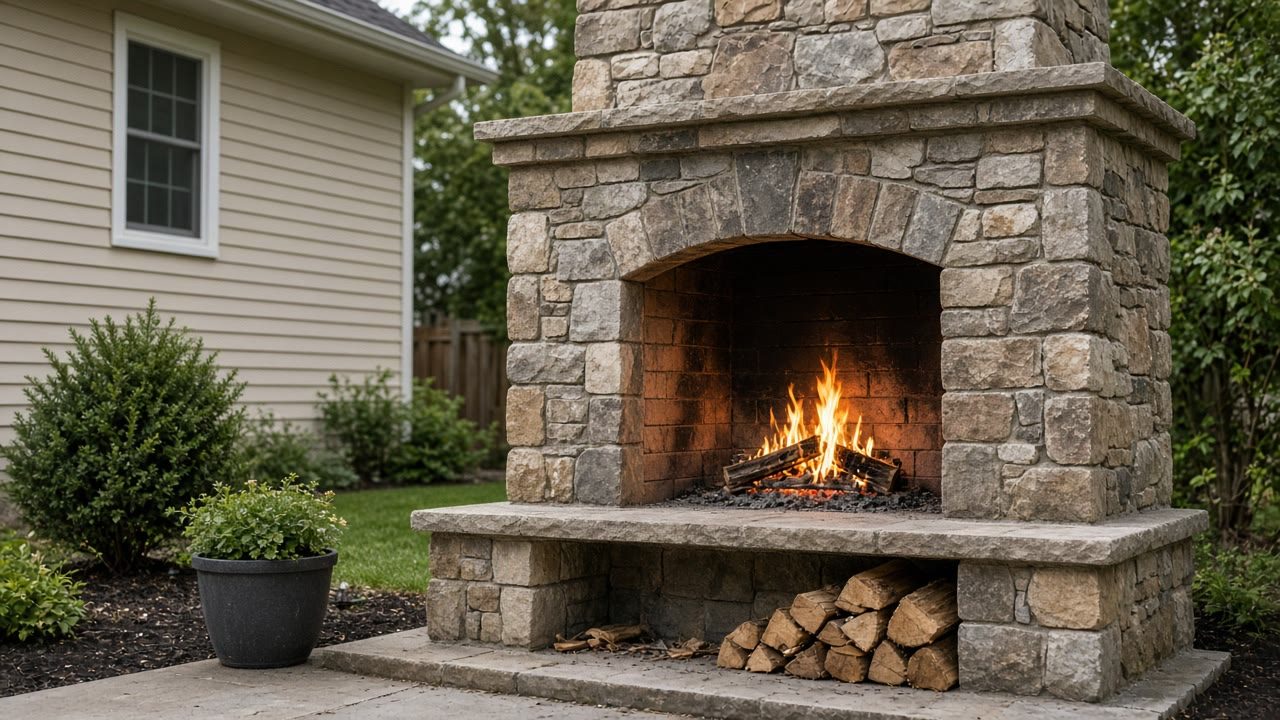
This is the town where the base specification stops being a number off a chart. A 4 inch base is written for well drained soil, and 6.2 percent of Cicero is well drained. With Niagara silt loam holding water a foot below the surface from December through May, the excavation is often open in the wet months at the exact depth the water sits, and a patio built on a saturated subgrade moves whatever the surface looks like on handover day.
Tell us what you want built in Cicero
Describe the project and the month you had in mind, and we will tell you what the specification actually needs.
Patio and walkway questions from Cicero
What base does a patio actually need in Cicero?
The Town of Cicero lists fireplaces among the work needing a building permit and does not list a patio at grade. For paving the consequence is that the base depth and the drainage are set by your own parcel rather than by a figure someone quotes from memory.
My paving has moved a little. Was it built badly?
Not necessarily. A small amount of settlement is expected on unit paving, and it is one of the reasons unit paving gets used: it flexes at the joints where a rigid slab would crack, and single units can be lifted and reset. What is not expected is a hollow that keeps deepening, or one holding water days after a storm. Those point at compaction or drainage underneath rather than at the surface.
Get a Cicero quote you can read
Send the details and we will connect you with licensed, insured contractors who put the base, the drainage and the dates in writing.