
Onondaga County
Masonry Installation in DeWitt: What Is Under the Grass
Before anyone prices a fireplace, a pillar or a flight of stone steps in DeWitt, find out what is actually under the grass. About a quarter of the town is mapped as urban land, quarries and cut and fill rather than natural soil, and made ground is the case where bearing gets checked instead of assumed.
Request a quote in DeWitt
Share a few details so we can confirm coverage and arrange the right next step.
Would you rather talk it through? Call (315) 640-3590, answered 24/7.
$100 off your first job
Credited by us on your first booked job.
- One credit per customer per property, on your first booked job.
- Valid through December 31, 2026.
Mention this offer when you book. Full terms.
DeWitt's quarry and fill ground, and what a footing has to reach
In the Town of DeWitt, 28.9 percent of the mapped soil area is classed poorly drained, somewhat poorly drained or very poorly drained, and 26.8 percent is classed well drained. Niagara silt loam is the largest single map unit at about 11.8 percent, and a further quarter of the town carries no natural drainage class at all because it is mapped as urban land at about 8.9 percent, quarries at about 6.5 percent and cut and fill land at about 6.1 percent.
Source: United States Department of Agriculture, Natural Resources Conservation Service, Soil Survey Geographic Database for Onondaga County New York, survey area NY067, queried through the Soil Data Access service, accessed 2026-09-14
Section R403.1.4 of the Residential Code of New York State, Minimum Depth, requires exterior footings to be placed not less than 12 inches below the undisturbed ground surface, and states that where applicable the depth of footings shall also conform to Section R403.1.4.1, the frost protection section. Twelve inches is a floor, not the answer: it is the minimum before frost is considered at all.
Source: 2020 Residential Code of New York State, Chapter 4, Foundations, via UpCodes, accessed 2026-09-14
Section R403.1.4.1 carries three exceptions to the frost protection requirement. Protection is not required for free-standing accessory structures with an area of 600 square feet or less of light-frame construction with an eave height of 10 feet or less; nor for free-standing accessory structures with an area of 400 square feet or less of other than light-frame construction with an eave height of 10 feet or less; and decks not supported by a dwelling need not be provided with footings that extend below the frost line.
Source: 2020 Residential Code of New York State, Chapter 4, Foundations, via UpCodes, accessed 2026-09-14
There is no state-wide or county-wide frost depth figure in the New York code. Section R301.2 states that additional criteria shall be established by the local jurisdiction and set forth in Table R301.2(1), and the table's own footnote for the frost line depth column reads: the jurisdiction shall fill in the frost line depth column with the minimum depth of footing below finish grade. The column is published blank.
Source: 2020 Residential Code of New York State, Section R301.2 and Table R301.2(1), Climatic and Geographic Design Criteria, via UpCodes, accessed 2026-09-14
Fire feature on fill? Ask for a test hole
Send your DeWitt address and what you want built, and we will arrange quotes that say how deep the footing goes and why.
Made ground in DeWitt, and who sets the footing depth
Niagara silt loam is still the largest single map unit in DeWitt at about 11.8 percent, but urban land, quarries and cut and fill land together account for roughly a quarter of the town, and none of those carries a natural drainage class at all. If your property sits on old fill, say so at quote stage, because it changes both the base under paving and the footing under anything that carries weight. The footing question then has two published halves and one local one. New York requires an exterior footing to sit at least 12 inches below undisturbed ground before frost is considered, and it exempts some small free standing structures from frost protection altogether, which is exactly why two honest contractors can quote 12 inches and 48 inches for the same fire feature. The number that settles it is your municipality's, because the state code leaves the frost line depth column blank for the local jurisdiction to fill in. Ask DeWitt code enforcement for their figure before you compare the two prices. Jamesville is covered from this page.
Areas within DeWitt: Jamesville
Installation work we arrange in DeWitt and Jamesville
Stone and Brick Veneer Installation
Put stone or brick veneer on a wall, chimney chase, column or foundation face, with the barrier, flashing and weep screed behind it built as a drainage path rather than as a finish.
Stone Veneer in DeWitt →Paver Patios, Walkways and Stone Steps
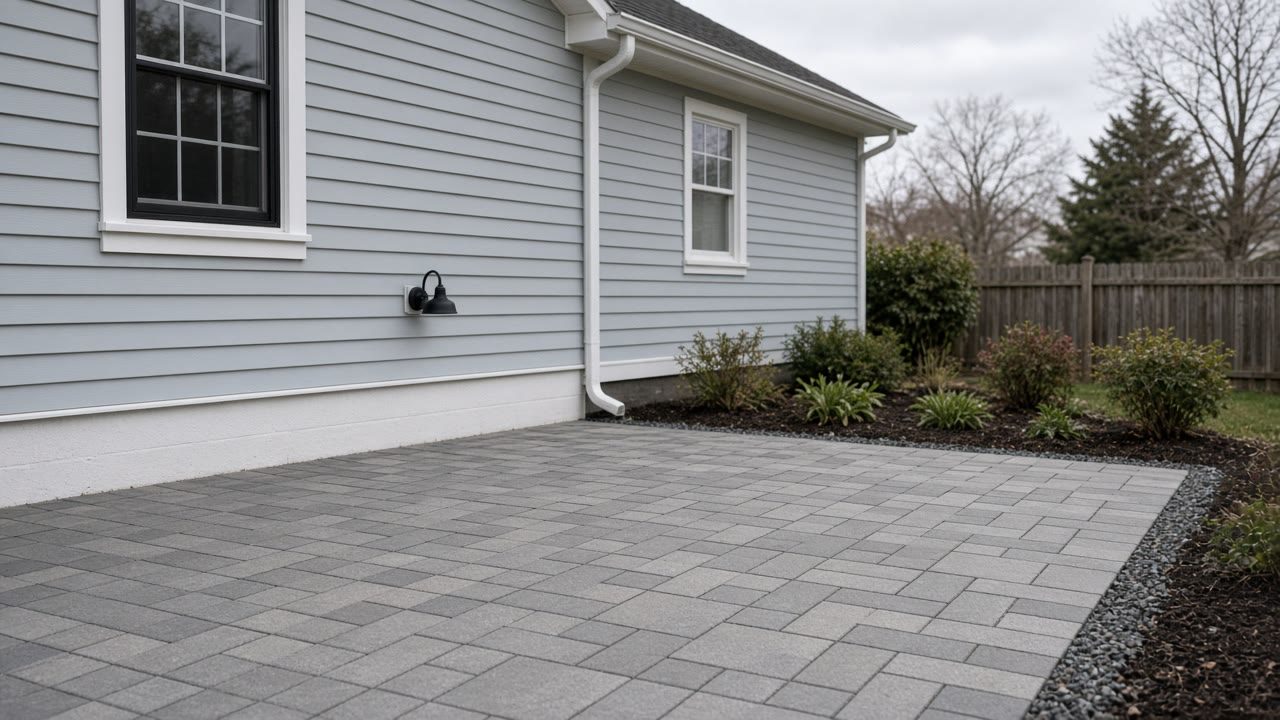
Have a patio, walkway, driveway or set of stone steps built in unit pavers or natural stone, with the base depth, the compaction and the drainage written into the quote as numbers you can check.
Paver Patio Installation in DeWitt →Outdoor Fireplaces, Fire Pits and Kitchens
Build a masonry fire feature, outdoor kitchen, seat wall or pillar in the yard, sized to the state's rules on open fires and sitting on a footing your own code office has agreed to.
Outdoor Living Masonry in DeWitt →Masonry Cleaning, Efflorescence and Sealing
Find out what the white bloom, the staining or the clouded surface on your masonry is reporting, and whether cleaning or sealing is worth paying for at all.
Masonry Cleaning and Sealing in DeWitt →Two DeWitt quotes, two footing depths
Tell us what you are planning and we will help you work out which one is describing your ground.