
Stone and Brick Veneer in North Syracuse
What decides whether veneer lasts in North Syracuse is the assembly behind it, and it is visible for about a day.
Stone Veneer quote in North Syracuse
Share a few details so we can confirm coverage and arrange the right next step.
Would you rather talk it through? Call (315) 640-3590, answered 24/7.
$100 off your first job
Credited by us on your first booked job.
- One credit per customer per property, on your first booked job.
- Valid through December 31, 2026.
Mention this offer when you book. Full terms.
The North Syracuse record behind this page
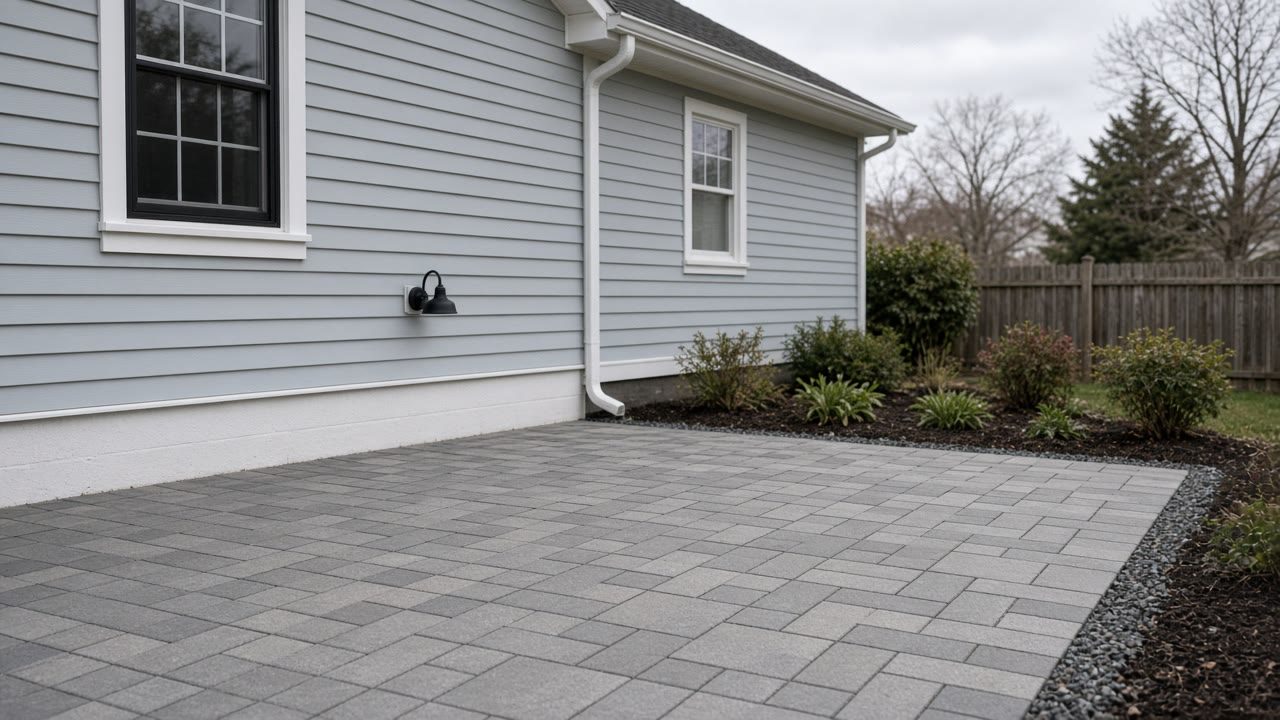
The county hazard mitigation plan describes the Bear Trap and Ley Creek Drainage District, which runs through North Syracuse, East Syracuse and the built-up ground between them, as flat and heavily urbanized, making the lowest areas extremely vulnerable to flood events that approach or exceed the five year storm, and states that this occurs about three times a year. The Village of East Syracuse annex records that it has no jurisdiction or oversight over the district, and its own action to study the most at-risk properties was discontinued for that reason.
Source: Onondaga County, New York, 2025 Hazard Mitigation Plan, Village of North Syracuse Annex and Village of East Syracuse Annex, Onondaga County Department of Planning, accessed 2026-09-14
National Flood Insurance Program figures in the county hazard mitigation plan annexes show how differently water behaves across the northern towns. The Town of Cicero has 180 active policies and 153 claims paid totalling about 1.44 million dollars. The Town of Clay has 93 policies and 49 claims paid totalling 455,606 dollars, and no repetitive loss or severe repetitive loss properties. North Syracuse village has 4 policies and has had no claims paid at all, a total of zero dollars. Solvay village has 3 policies and 6 claims paid totalling 10,957 dollars, and East Syracuse village has 9 policies and 12 claims paid totalling 223,722 dollars.
Source: Onondaga County, New York, 2025 Hazard Mitigation Plan, Town of Cicero Annex, Town of Clay Annex and Village of North Syracuse Annex, Onondaga County Department of Planning, accessed 2026-09-14
Three municipalities in this metro authorized no new single-family housing units at all in 2022, 2023 or 2024: Camillus village, East Syracuse village and North Syracuse village. Liverpool village authorized one over the three years, and Baldwinsville village and Fayetteville village two each. Read alongside the housing age data, East Syracuse village and Solvay village both report 0.0 percent of their housing built in 2000 or later.
Source: US Census Bureau, Building Permits Survey, annual place-level data for the Northeast Region, 2022, 2023 and 2024, accessed 2026-09-14
Two further numbers from the same document. Base material is to be spread and compacted in 4 to 6 inch lifts using a 7,000 pound-force reversible plate compactor, with thinner lifts required for compactors in the 5,000 pound-force range. And the finished surface must drain: slopes should be a minimum of 1.5 percent.
Source: Concrete Masonry and Hardscapes Association, PAV-TEC-002, Construction of Interlocking Concrete Pavements, accessed 2026-09-14
Section R703.12.2 of the Residential Code of New York State, Flashing at Foundation, requires that for adhered masonry veneer on exterior stud walls a corrosion-resistant screed or flashing of a minimum 0.019 inch, or 26 gage, galvanized or plastic, with a minimum vertical attachment flange of 3 1/2 inches, shall be installed to extend a minimum of 1 inch below the foundation plate line.
Source: 2020 Residential Code of New York State, Section R703, Exterior Covering, via UpCodes, accessed 2026-09-14
Section R703.12.3 requires a water-resistive barrier behind adhered masonry veneer and states that the water-resistive barrier shall lap over the exterior of the attachment flange of the screed or flashing provided in accordance with Section R703.12.2. The lap direction is the whole point: the barrier over the flange carries water out of the wall, and the barrier behind the flange carries it in.
Source: 2020 Residential Code of New York State, Section R703, Exterior Covering, via UpCodes, accessed 2026-09-14
Section R703.1.1 of the Residential Code of New York State states the governing principle for every cladding on a frame wall: the exterior wall envelope shall be designed and constructed in a manner that prevents the accumulation of water within the wall assembly by providing a water-resistant barrier behind the exterior cladding as required by Section R703.2, and a means of draining to the exterior water that penetrates the exterior cladding.
Source: 2020 Residential Code of New York State, Section R703, Exterior Covering, via UpCodes, accessed 2026-09-14
The masonry industry's own construction specification sets its cold weather trigger at 40 degrees Fahrenheit, not at freezing. Brick Industry Association Technical Note 1 states that the primary purpose of the cold weather construction procedures is to achieve complete hydration of the cement, which occurs only when material temperatures are 40 degrees Fahrenheit or higher, and that as ambient temperatures fall the chemical reaction slows and may stop completely unless adequate heat is maintained in the mortar or grout. The consequence it names is incomplete cement hydration producing soft, friable mortar with reduced durability.
Source: Brick Industry Association, Technical Note 1, Hot and Cold Weather Construction, accessed 2026-09-14
What flat, built-up ground that floods without flooding houses means for a veneer wall in North Syracuse
North Syracuse village authorized no new single-family homes across three years, so veneer work here is almost always going onto an existing house. That makes the wall assembly behind the stone the real subject: what is already there, what it laps over, and whether water reaching the bottom of the wall can get out.
Deciding on veneer in North Syracuse
The county hazard mitigation plan describes the Bear Trap and Ley Creek Drainage District, which runs through North Syracuse, as flat and heavily urbanized, and says its lowest areas are extremely vulnerable to events approaching or exceeding the five year storm, which happens about three times a year.
The month decides the specification
Mortar reaches full strength only at 40F or above, so a veneer job that runs past early October is one where the setting bed and the scratch coat need heat and cover rather than optimism.
What is behind and beneath the work
The stone is not what keeps water out of a veneer wall. The barrier, the lath, the flashing and the weep screed at the base do that, with the barrier lapping over the screed's flange so water leaving the assembly is carried out rather than back in.
What to ask whoever quotes
Ask to see the base of the wall before the stone goes on. The screed and the lap direction are visible for about a day, and invisible for the next thirty years.
Tell us what you want built in North Syracuse
Describe the project and the month you had in mind, and we will tell you what the specification actually needs.
Other masonry we arrange in North Syracuse
Stone veneer questions from North Syracuse
Is North Syracuse ground a problem for stone veneer?
North Syracuse village authorized no new single-family housing units in 2022, 2023 or 2024, and has never had a flood insurance claim paid. For a veneer job the practical consequence is that the wall has to be able to dry outward and discharge at its base, whatever the ground in front of it is doing.
How can I tell the wall behind my veneer was detailed properly?
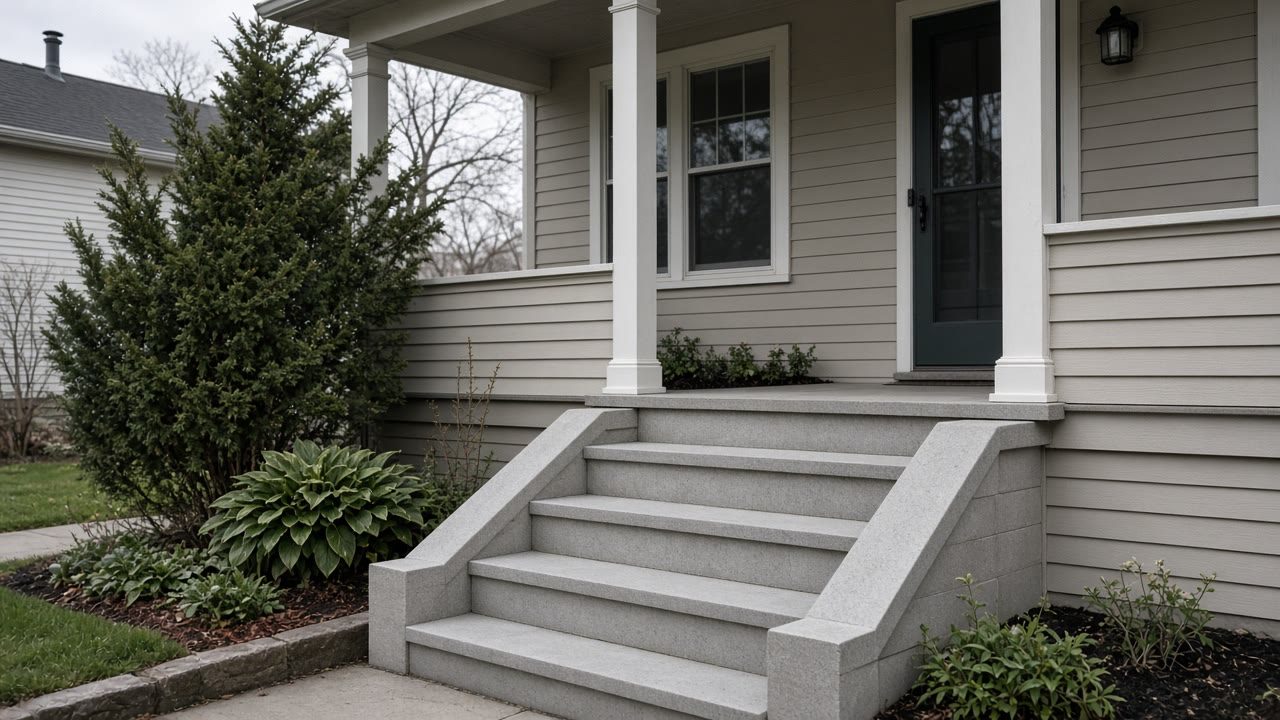
Look at the bottom edge from your own driveway, which costs nothing. A metal screed should run along the base of the stonework with a gap under its lip so water can leave, and the barrier above should lap over that flange rather than tuck behind it. The stone should also hold a clearance above soil or paving. If the last course disappears into mulch or blacktop, whatever gets behind that wall has no way out.
Get a North Syracuse quote you can read
Send the details and we will connect you with licensed, insured contractors who put the base, the drainage and the dates in writing.