
Outdoor Fireplaces and Fire Pits in Camillus
A fire feature is a foundation, and in Camillus the depth it reaches is the town's number, not the state's.
Outdoor Living Masonry quote in Camillus
Share a few details so we can confirm coverage and arrange the right next step.
Would you rather talk it through? Call (315) 640-3590, answered 24/7.
$100 off your first job
Credited by us on your first booked job.
- One credit per customer per property, on your first booked job.
- Valid through December 31, 2026.
Mention this offer when you book. Full terms.
Fire features in Camillus, and who sets the footing
Camillus is the town to read the checklist for. Its residential permit paperwork requires proof of New York State Workers Compensation insurance for the contractor doing the work, naming form U-26.3 from the State Insurance Fund, C-105.2 or GSI-105.2, form WC/DB-100 where a contractor has no employees, or BP-1 where the homeowner is doing the work. A driveway permit comes from the county, the town highway department or the state depending on the road.
What outdoor living masonry involves
What to settle before building in Camillus
Camillus is 57.5 percent well drained against 14.2 percent poorly drained, and the dominant soils are glacial till: Ontario gravelly loam and Ontario loam, Camillus silt loam, and Ontario and Madrid soils on slopes running from 3 to 25 percent.
The month decides the specification
Footing concrete has its own cold weather rules, separate from the mortar above it, and fresh concrete that freezes can lose more than half the strength it was meant to reach. A late footing pour is the part of this job that cannot be corrected later.
What is behind and beneath the work
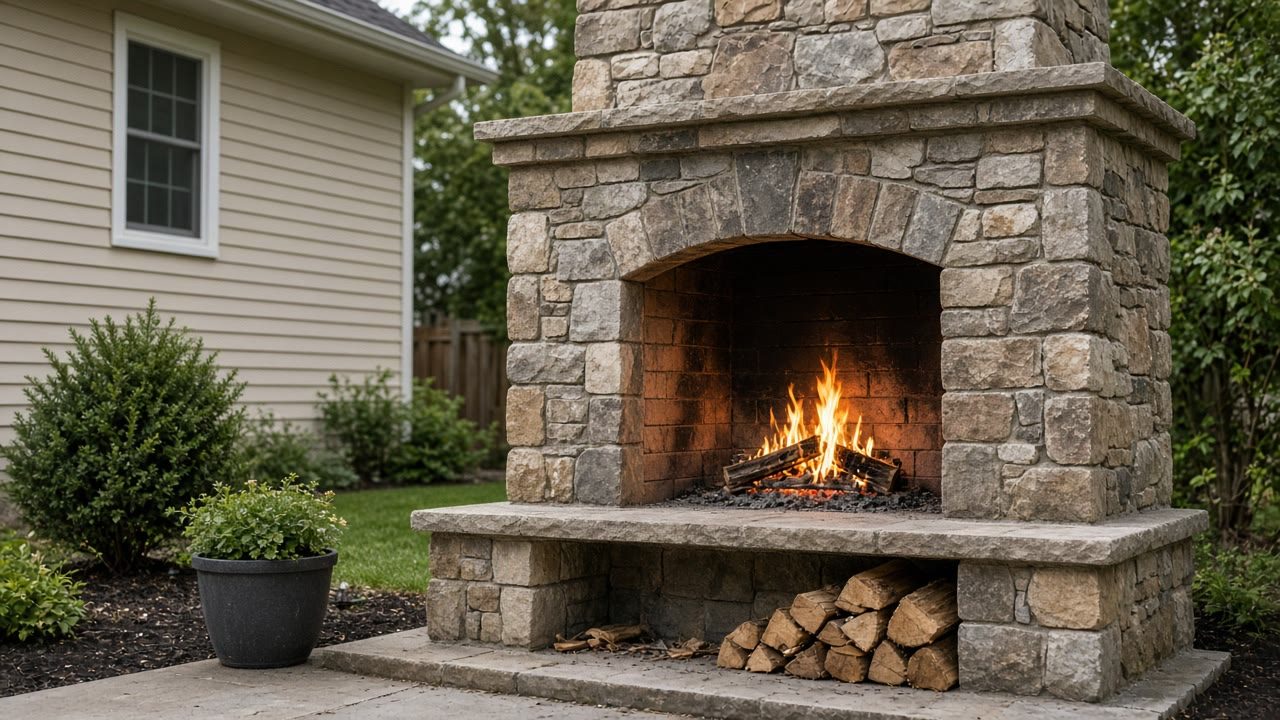
A fire feature is a foundation with a fire in it. New York publishes no statewide or county frost depth at all, the code column is blank, and your own municipality fills the number in, which is why two honest masons can quote very differently and both be right.
What to ask whoever quotes
Ask two things: what footing depth the town requires, and what size the fire opening is going to be. State rules cap a lawful open fire at under 3 feet high and under 4 feet across.
The Camillus rules that apply here
The Town of Camillus residential building permit checklist requires proof of New York State Workers Compensation insurance for the contractor performing the work, naming the acceptable forms as U-26.3 from the New York State Insurance Fund, C-105.2 or GSI-105.2, and allowing form WC/DB-100 where a contractor has no employees, or form BP-1 where the homeowner is doing the work themselves. The same checklist requires a driveway permit from Onondaga County Department of Transportation, the Town of Camillus Highway Department or New York State Department of Transportation depending on the road, and a Phase II stormwater permit if one or more acres will be disturbed during construction.
Source: Town of Camillus, New York, Code Enforcement Office, Residential Building Permit Requirements Checklist, revised March 3 2023, accessed 2026-09-14
In the Town of Camillus, 14.2 percent of the mapped soil area is classed poorly drained, somewhat poorly drained or very poorly drained, and 57.5 percent is classed well drained. The dominant soils are well drained glacial till: Ontario gravelly loam on 8 to 15 percent slopes at about 9.7 percent, Ontario loam on 3 to 8 percent slopes at about 9.6 percent, Camillus silt loam on 2 to 6 percent slopes at about 6.6 percent and Ontario and Madrid soils on 15 to 25 percent slopes at about 6.5 percent.
Source: United States Department of Agriculture, Natural Resources Conservation Service, Soil Survey Geographic Database for Onondaga County New York, survey area NY067, queried through the Soil Data Access service, accessed 2026-09-14
The Census Building Permits Survey counts new single-family housing units authorized by each permit-issuing place, which is the closest published proxy for where new masonry is actually being built. Across 2022, 2023 and 2024 combined, Onondaga County municipalities authorized new single-family units as follows: Town of Lysander 178, Town of Clay 89, Town of Camillus 86, Town of Onondaga 83, City of Syracuse 56, Town of Cicero 37, Town of Manlius 34, Town of Skaneateles 23, Town of DeWitt 17, Town of Van Buren 15, Town of Marcellus 14, Marcellus village 13, Town of Geddes 11, Skaneateles village 9, Manlius village 8, Town of Salina 8, Solvay village 4, Baldwinsville village 2, Fayetteville village 2, Liverpool village 1, and Camillus village, East Syracuse village and North Syracuse village 0 each. In 2024 alone the county authorized 323 new single-family units with a combined reported construction value of about 101.3 million dollars.
Source: US Census Bureau, Building Permits Survey, annual place-level data for the Northeast Region, 2022, 2023 and 2024, accessed 2026-09-14
Ranked by the share of housing units built in 2000 or later, the era in which adhered stone veneer and segmental paver hardscape became the dominant new masonry products, the places of this metro spread very widely. Radisson, the census place inside the Town of Clay, leads at 32.4 percent, followed by the Town of Lysander at 25.8 percent, the Town of Van Buren at 21.9 percent, Baldwinsville village at 20.1 percent, the Town of Cicero at 19.1 percent, the Town of Clay at 15.4 percent, the Town of Camillus at 15.2 percent, the Town of Manlius at 11.6 percent, the Town of Marcellus at 11.3 percent, the Town of Skaneateles at 11.2 percent, Marcellus village at 9.9 percent, the Town of DeWitt at 8.7 percent, Skaneateles village at 8.4 percent, Fayetteville village at 8.1 percent, the Town of Salina at 7.0 percent, the City of Syracuse at 6.4 percent, Camillus village at 6.4 percent, Liverpool village at 6.1 percent, North Syracuse village at 4.7 percent, Manlius village at 4.5 percent, and both East Syracuse village and Solvay village at 0.0 percent. The county figure is 11.6 percent.
Source: US Census Bureau, American Community Survey 2020-2024 5-year estimates, table B25034 Year Structure Built and table B25035 Median Year Structure Built, accessed 2026-09-14
There is no state-wide or county-wide frost depth figure in the New York code. Section R301.2 states that additional criteria shall be established by the local jurisdiction and set forth in Table R301.2(1), and the table's own footnote for the frost line depth column reads: the jurisdiction shall fill in the frost line depth column with the minimum depth of footing below finish grade. The column is published blank.
Source: 2020 Residential Code of New York State, Section R301.2 and Table R301.2(1), Climatic and Geographic Design Criteria, via UpCodes, accessed 2026-09-14
New York's own code agency confirms it. Technical Bulletin TB-1009-RCNYS from the Department of State Division of Building Standards and Codes states, under Subject to damage from Frost Line Depth, that the local jurisdiction shall provide the minimum depth of footing below finish grade, and that the considerations a local jurisdiction can use when developing its frost line depth include, but are not limited to, air freezing index, soil type, water table depth, local historical data and field experience. The bulletin also notes that where an authority having jurisdiction spans multiple municipalities the data should be filled out for each municipality individually.
Source: New York State Department of State, Division of Building Standards and Codes, Technical Bulletin TB-1009-RCNYS, Requirements for Completing Table R301.2(1) in the 2020 Residential Code of New York State, accessed 2026-09-14
Section R403.1.4.1 carries three exceptions to the frost protection requirement. Protection is not required for free-standing accessory structures with an area of 600 square feet or less of light-frame construction with an eave height of 10 feet or less; nor for free-standing accessory structures with an area of 400 square feet or less of other than light-frame construction with an eave height of 10 feet or less; and decks not supported by a dwelling need not be provided with footings that extend below the frost line.
Source: 2020 Residential Code of New York State, Chapter 4, Foundations, via UpCodes, accessed 2026-09-14
New York caps the size of a legal outdoor fire. The Department of Environmental Conservation states that campfires, small cooking fires, or any other outdoor fire less than 3 feet in height and 4 feet in length, width or diameter are allowed, that all fires must consist of only charcoal or dry, clean, untreated and unpainted wood, that the burning of brush is prohibited from March 16 through May 14, and that towns, villages, cities and counties can pass ordinances that are stricter than Part 215. The underlying regulation, 6 NYCRR 215.3(c), permits small fires used for cooking and camp fires provided that only charcoal or untreated wood is used as fuel and the fire is not left unattended until extinguished.
Source: New York State Department of Environmental Conservation, Open Burning, and 6 NYCRR section 215.3, Exceptions and restricted burning, via the Cornell Legal Information Institute, accessed 2026-09-14
The footing concrete under new masonry has its own cold weather rules. The National Ready Mixed Concrete Association defines cold weather as a period when the average daily temperature is below 40 degrees Fahrenheit for more than three consecutive days and the air temperature is not above 50 degrees for more than half of any 24 hour period. It states that fresh concrete freezes if its temperature falls below about 25 degrees Fahrenheit, that the potential strength of frozen concrete can be reduced by more than 50 percent and it will not be durable, and that concrete should be protected from freezing until it reaches 500 pounds per square inch, about two days after placement.
Source: National Ready Mixed Concrete Association, Concrete in Practice 27, Cold Weather Concreting, accessed 2026-09-14
Tell us what you want built in Camillus
Describe the project and the month you had in mind, and we will tell you what the specification actually needs.
Other masonry we arrange in Camillus
Fire feature questions from Camillus
What does Camillus require before a fire feature goes in?
The Town of Camillus requires proof of contractor Workers Compensation coverage on its residential permit checklist, naming forms U-26.3, C-105.2, GSI-105.2, WC/DB-100 and BP-1. For a fire feature the consequence is that the footing depth comes from your municipality, because New York publishes no figure of its own.
How large can an outdoor fire lawfully be in New York?
State rules cap a lawful open outdoor fire at under 3 feet high and under 4 feet in length, width or diameter, burning charcoal or dry clean untreated unpainted wood only, and a local ordinance can be stricter. Anything wider than 4 feet falls outside that exception. Worth settling before a design is agreed: the dimension is trivial to change on a drawing and expensive to change once it is built.
Get a Camillus quote you can read
Send the details and we will connect you with licensed, insured contractors who put the base, the drainage and the dates in writing.